



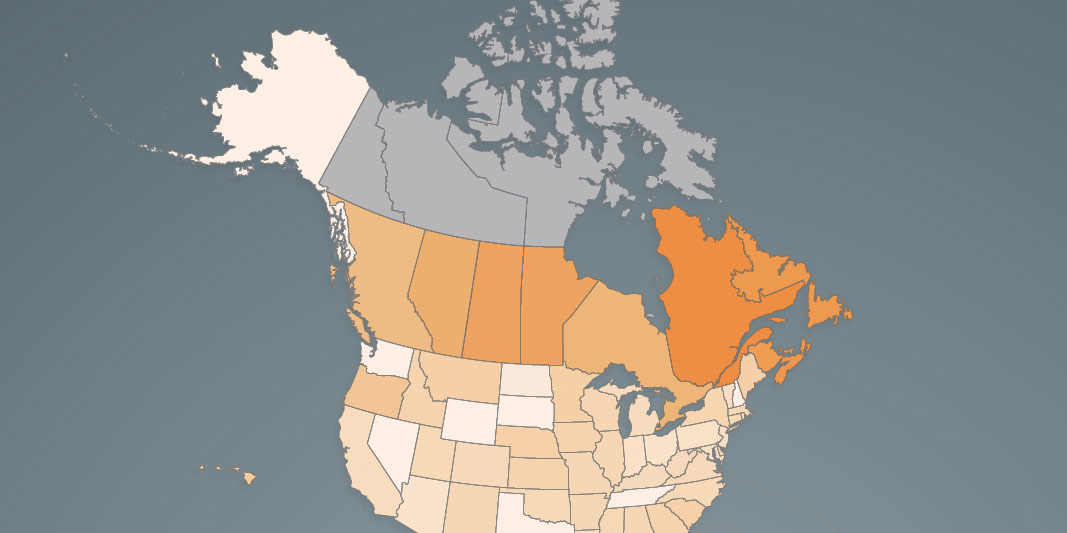
VANCOUVER, BC-While politicians in Ottawa argue over how
much additional money the government should give business in
the name of economic stimulation, a new report from independent
research organization the Fraser Institute shows that Canadians
already provided more than $182 billion in corporate welfare to
businesses between 1994 and 2006.
That works out to $13,639 per tax payer over that
twelve-year period or $1,291 per tax payer in 2006 alone.
"While corporate begging has become even more blatant this
year, the fundamental truth has not changed. Business
subsidies, bailouts, or loans are all forms of corporate
welfare that transfer tax dollars and employment from healthy
businesses to risky businesses," said Mark Milke, author of the
report,
Corporate Welfare: Now a $182 Billion Addiction.
"Government intervention only delays the day of reckoning
and often at the expense of other businesses and a healthy
industry and economy."
Milke last wrote on corporate welfare for the Fraser
Institute in 2007. This latest report contains two years of
additional data and a reflection on the current demands for
more corporate welfare underway in both Ottawa and
Washington.
Peer-reviewed research on business subsidies concludes that
corporate welfare may not have a demonstrable positive impact
upon the economy, employment, and tax revenues because of the
substitution effect. The substitution effect occurs when
employment and tax revenues are shifted to business at a
significant cost, and no new investment or employment is
created, on a net basis, when the national or international
economy is considered. For example, a subsidy meant to "create"
manufacturing jobs in Quebec may simply shift intended
investment from Ontario or British Columbia. A subsidy offered
to an automotive company in Michigan will tend to shift jobs
from Ontario or Kentucky.
With much attention recently focussing on the auto industry,
Milke points out that since 2004 alone, the federal and Ontario
governments together promised $752 million to the automotive
industry, including $200 million for Ford, $200 million for GM,
and $125 million for Toyota. And now the automotive industry is
asking for additional billions in corporate welfare
payments.
"Even though research does not support claims that corporate
welfare contributes to widespread economic growth, governments
continue to pursue these policies because they want to be seen
to be doing something," Milke said.
"By subsidizing or bailing out failing businesses,
politicians can tell voters they are saving jobs, or they can
appeal to voters with interests in specific industries."
Milke's findings include:
- Between 1994 and 2006, the last year for which statistics
are available, Canada's federal, provincial, and local
governments spent $182.4 billion on subsidies to
business.
- In 2006 alone, Canada's federal, provincial, and local
governments spent $19.3 billion on corporate welfare, almost
double the 1995 figure of $10.3 billion.
- The total corporate welfare bill (federal, provincial,
and municipal) has ranged from a low of $9.9 billion in 1996
to a high of almost $20 billion in 2005. In 2006, it amounted
to $19.3 billion.
- The cost to each taxpayer who paid income tax in 2006 was
$1,291, which was 38% higher than the 1995 figure of
$934.
- Over 12 years, the total cost per tax filer who paid tax
amounted to $13,639 per person (all figures adjusted for
inflation to 2008 dollars).
- Between 1994 and 2006, provincial governments spent $98.5
billion on corporate welfare, while the federal government
spent $61.4 billion and municipal governments spent $22.5
billion.
- Among provincial governments, the province which
disburses the most amount of public money to corporations is
Quebec, with over $5.4 billion in corporate welfare in 2006.
Quebec was followed by Ontario at $2.4 billion and Alberta at
almost $1.5 billion, with British Columbia fourth at just
under $950 million.
"The old cliché that what is good for certain large
corporations is good for the country has never been less true
than it is today. With multiple companies lining up around the
world for government-financed grants, loans and loan
guarantees, bailouts for one company in trouble will merely
make it more difficult for other healthy competitors in a tough
economic environment," Milke said.