VANCOUVER, B.C.-Alberta has traditionally been ranked as
having the best investment climate in Canada but it's now
facing competition as both Saskatchewan and British Columbia
have made recent gains, according to a new study released today
by the Fraser Institute, one of Canada's leading economic
think-tanks.
"For years Alberta enjoyed the so-called Alberta advantage,
a combination of low taxes, small government, and the most
attractive investment climate in the country. What we're seeing
now is a chipping away of that advantage, as both Saskatchewan
and B.C. have reduced business taxes and introduced other
policies that encourage capital investment," said Niels
Veldhuis, Fraser Institute director of fiscal studies and
co-author of the 2009 edition of the Institute's
Canadian Provincial Investment Climate Report
.
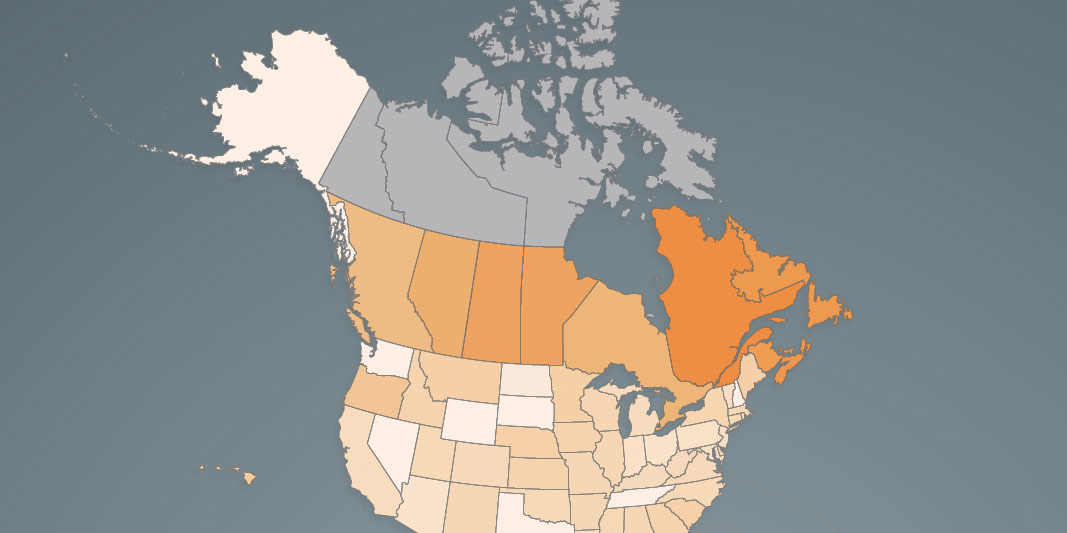
Although Alberta again tops the rankings in the 2009 report
with an overall score of 8.5 out of 10, its lead over
Saskatchewan and B.C. has shrunk this year. Saskatchewan is
second overall with a score of 6.6 out of 10 followed by
British Columbia at 6.0 out of 10.
"As Saskatchewan and B.C. close the gap on Alberta, we're
seeing a growing dominance by Western Canada in terms of
government initiating policies that make the provinces
attractive for investment," Veldhuis said.
"There's a substantial body of research that shows
jurisdictions that implement policies that promote a positive
investment climate are more likely to experience economic
success and job creation."
While Saskatchewan and B.C. are catching up to Alberta,
Ontario and Quebec are falling farther behind. Ontario is
ranked fifth overall but with a score of 4.9. Quebec, the
country's second largest province, does even poorer, tied for
eighth overall with a score of just 3.3.
"If Alberta is the benchmark by which other provinces are
measured in terms of attracting investment, Ontario and Quebec
are falling behind as the gap in their scores has increased in
2009," Veldhuis said.
"To revitalize Ontario's economy, the provincial government
needs to re-establish Ontario as one of the most attractive
places to invest in Canada."
Among the remaining provinces, Newfoundland & Labrador
ranks fourth with a score of 5.4 out of 10, the only other
province aside from Alberta, Saskatchewan, and B.C. to earn a
score above 5.0. Manitoba is sixth overall with a score of 4.7,
New Brunswick ranks seventh with a score of 4.4. Nova
Scotia scored 3.3 to tie for eighth place with Quebec, and
Prince Edward Island scored 3.2 to put it last in 10th
place.
The index is composed of seven components identified by
Canadian investment managers and academic research as the most
important contributors to investment climates: corporate income
tax, fiscal prudence, personal income tax, transportation
infrastructure, corporate capital tax, labour market
regulation, and overall burden of regulation.
Alberta ranks first on most indicators including corporate
income taxes, corporate capital taxes, personal income taxes,
fiscal prudence, and labour market regulation. It ranks second
on the overall burden of government regulations or "red tape."
However, Alberta ranks seventh out of 10 on transportation
infrastructure with a score of 5.7 out of a possible 10. This
component assesses the transportation infrastructure in each
province, including highways, urban transit, air, rail, and
marine service by examining the extent, use, accessibility,
cost, and condition of each mode of transportation.
Saskatchewan and British Columbia closed the gap with
Alberta in measures on corporate income tax and corporate
capital tax. Saskatchewan (placing second) tops B.C. (placing
fourth) on fiscal prudence which measures how well provincial
governments have managed their budgets and whether government
spending is sustainable. Saskatchewan ranks second on corporate
capital taxes with B.C. third. Saskatchewan also ranks third on
burden of government regulation while B.C. is sixth. But the
overall scores of both provinces were dragged down by their
performance on transportation infrastructure (Saskatchewan
ranks ninth and B.C. 10th).
Ontario scores relatively well in transportation
infrastructure and labour market regulation, placing
second in each category. It ranks in the middle of the
pack on personal income taxes (fourth), corporate capital tax
(fifth), and the overall burden of government regulations
(fifth). But poor performance in fiscal prudence (sixth), where
the gap between Ontario and Alberta widened, and corporate
income tax (seventh) drags its overall ranking down.
Quebec fares relatively well on corporate income taxes,
placing third, but poorly on all other indicators.
Significantly, Quebec ranks last in fiscal prudence, labour
market regulation, and burden of regulation, and ninth in
corporate capital tax.
The Atlantic provinces - New Brunswick, Nova Scotia, and
Prince Edward Island - trail the rest of the country in fiscal
prudence and burden of regulation. There are some bright spots
with Nova Scotia ranking first overall for transportation
infrastructure and New Brunswick third. New Brunswick also
ranks fourth for personal income tax and corporate capital
tax.
"As the global recession fades, it's critical for all
provinces to seek ways to improve policies to encourage new
investment. Governments should pay special attention to
competitive tax rates, unnecessary red tape, and labour market
regulations," Veldhuis said.
"Capital investment is a leading contributor to economic
success and job creation. If provincial governments pursue
policies that discourage investment, Canadians will pay the
price through a weaker economy characterized by lower rates of
job creation, higher levels of unemployment, and slower income
growth."