




VANCOUVER, BC- Canadian provinces are failing to keep up to
U.S. states on some of the most important measures of
entrepreneurial activity, according to a new study released
today by independent research organization the Fraser
Institute.
"U.S. states appear to be doing a better job of encouraging
entrepreneurial activity than Canadian provinces. It is
critical that Canada develop the right policies to encourage
entrepreneurial activity," said Niels Veldhuis, co-author of
Measuring Entrepreneurship, Conceptual Framework and Empirical
Indicators and the Fraser Institute's director of fiscal studies.
"There is growing recognition that entrepreneurship is
critical to economic prosperity. Entrepreneurship encompasses
the process of bringing new ideas into the market, is a key
driver of economic change, and creates jobs, opportunities, and
wealth."
Measuring Entrepreneurship, Conceptual Framework and
Empirical Indicators
is the first study in a longer-term project to develop a
comprehensive measure of entrepreneurship. The study examines
the most important definitions of entrepreneurship and widely
cited and used measures of entrepreneurship.
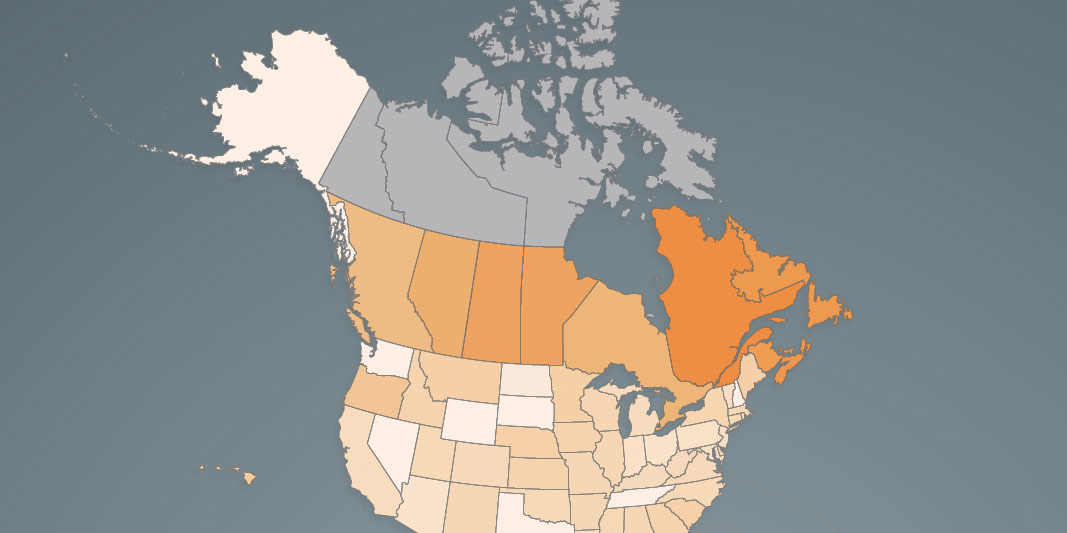
The study examines six indicators of entrepreneurship and
presents results and rankings for the 10 Canadian provinces and
50 U.S. states on each indicator.
The main measures explored in the study are:
1) Business creation: the process of starting a new
business, the primary way in which entrepreneurs commercialize
ideas and one of the most important measures of
entrepreneurship.
The top 10 jurisdictions with the highest net business
creation rates were U.S. states. Nevada had the highest net
small business creation rate at 5.2%. The highest ranking
Canadian province, Alberta (ranked 11th), had a net business
creation rate of 2.5%. BC and Ontario were the only other
provinces in the top half of the rankings; the remaining
provinces ranked 49th or lower.
2) Self-employment: individuals who make an
occupational choice and take the risk of working on their own,
rather than for an employer.
Canadian provinces generally had high rates of
self-employment and, as a result, all were in the top-half of
the 60 jurisdictions. BC is the top-ranked jurisdiction with a
self-employment rate of 11.9%.
"While self employment is one of the most commonly used
measures of entrepreneurship, there are several disadvantages
associated with it. Research shows that about half of the
variation in self-employment rates can be explained by
industrial composition and demographics," said Keith Godin,
study co-author and senior policy analyst at the Fraser
Institute.
3) Small businesses: defined as having 1-49 employees,
these businesses represent another vehicle though which
entrepreneurs bring innovations into the market.
There is very little variation among 60 jurisdictions in
terms of small businesses and Canadian provinces are
distributed throughout the rankings.
Quebec and Newfoundland ranked second and third, respectively,
on the number of businesses with 1-9 employees as a percentage
of total businesses. Ontario (54th) and Manitoba (59th) were
the lowest ranked provinces.
Manitoba ranked first on the number of businesses with 10-49
employees as a percentage of total businesses. The lowest
ranked jurisdiction was Quebec.
4) Venture capital: the resources raised for the
purpose of investing in potential high-growth businesses.
Of all the Canadian provinces and the U.S. states,
Massachusetts had the highest venture capital per person ($379)
in 2005. Massachusetts and California ($296 per person)
attracted significantly more venture capital to fund
entrepreneurial businesses than any other jurisdiction. Quebec,
the only province in the top 10, recorded $93 in venture
capital per person. Only three other provinces (Ontario, BC,
and Saskatchewan) ranked in the top half.
5) Research and development (R&D): the pursuit of a
new product or process and the part
of entrepreneurship that occurs within existing and
typically larger firms.
Canadian provinces trailed their U.S. counterparts on
industrial R&D spending. Michigan had the highest level of
industrial R&D spending as a percent of GDP at 4.3%.
Only two Canadian provinces were in the top half of the
rankings, Quebec at 18th and Ontario at 22nd. The remaining
Canadian provinces generally occupied the bottom quarter of the
rankings.
6) Patents: a proxy for the innovative aspect of
entrepreneurship.
Overall, the U.S. states far outperformed the Canadian
provinces in terms of their numbers of patents relative to
population. In fact, all Canadian provinces were in the bottom
third of the rankings. The top six states-Idaho, Vermont,
California, Massachusetts, Oregon, and Minnesota-generated more
than five times the number of patents, relative to population,
than Alberta, the highest ranked Canadian province (42nd).
"There are several other measures of entrepreneurship that
are worth examining such as the level of business expansion,
innovation, initial public offerings and business losses.
Unfortunately, current data are either not available or
comparable," Godin said.
Measuring Entrepreneurship, Conceptual Framework and
Empirical Indicators
lays the groundwork for developing a comprehensive measure of
entrepreneurship.
"Our goal is to determine more precisely where
entrepreneurship flourishes and why some regions have more
entrepreneurship than others. This will allow us to more
accurately assess the effectiveness of government polices aimed
at increasing the level of entrepreneurship," Veldhuis
said.