
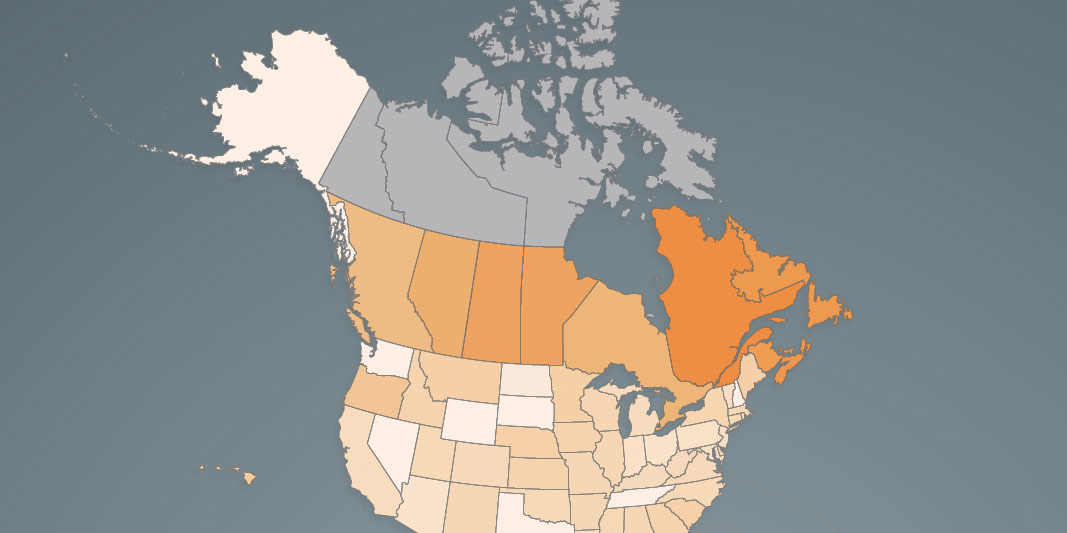
Drivers in British Columbia, Ontario, Saskatchewan
and Manitoba pay more for auto insurance on average than drivers
in most other provinces, according to a new study released today
by independent research organization The Fraser Institute.
"In a straight dollar comparison of the average cost of auto
insurance premiums, three of the four most expensive provinces
were those with government-run auto insurance monopolies: BC,
Saskatchewan and Manitoba," said Brett Skinner, the Institute's
Director of Health, Pharmaceutical and Insurance Policy Research
and author of
The False Promise of Government Auto Insurance.
The study estimates the average cost of personal passenger auto
insurance premiums in all 10 provinces for 2004 and 2005 using
publicly available data. It applies the same data definitions
that government regulators require from private sector insurers
in six provinces to the published data of the government auto
insurance monopolies in the four remaining provinces.
The findings are consistent with other research that has analyzed
data from previous years using various different methods for
calculating average premiums.
"No matter how you slice it, most research shows that the average
cost of premiums is not cheaper under public auto insurance,
despite contrary claims by government auto insurers," Skinner
said.
The study also found that the only provinces where the cost of
auto insurance increased between 2004 and 2005 were BC,
Saskatchewan and Quebec, all of which have government-run auto
insurance. The largest decreases occurred in Alberta, New
Brunswick and Newfoundland and Labrador.
The study points out government-run auto insurance monopolies
experience a higher frequency of claims and suppress rates for
high-risk drivers below the actuarial cost of insuring them. The
suppression of rates for small numbers of high-risk drivers
requires all other premiums to be higher than actuarially
necessary to cover the difference.
However, Skinner noted that the ownership structure of the
insurer is not the primary factor in determining the overall cost
of auto insurance.
"One of the key drivers in auto insurance cost is how the product
is defined by government. Premiums simply cover the cost of
providing auto insurance. If government regulations require
generous and expensive auto insurance benefits, that gets
reflected in higher premium prices, whether or not the provider
is government or the private sector," Skinner said.
The study notes that provinces with government auto insurance
monopolies tend to require the most expensive benefit coverages
and as a result, require expensive premiums.
"Whether consumers think deluxe levels of coverage are necessary
or valuable is another question. Previous research comparing
international auto insurance systems suggests that when consumers
are given a choice, they prefer a lower level of benefit coverage
in exchange for lower premiums," Skinner said.
He concludes that drivers in BC, Saskatchewan, Manitoba, and
Quebec are not well served by the current auto insurance system
and should be asking for change.
"They should be asking why their provinces have eliminated their
choices as consumers and forced them to buy auto insurance from a
costly and unnecessary government-run monopoly," Skinner said.
"Quebec drivers and taxpayers should be seeking accountability
for the finances of their province's government-run auto insurer,
which this study has shown are in serious long-term deficit. And
drivers in other provinces should beware of misleading promises
regarding the value of public auto insurance because the evidence
clearly shows that competitive private sector markets produce
better results for consumers."