

TALLAHASSEE, FLORIDA
-A new study shows that states with small government, low
taxes, and labor market freedom enjoy greater benefits from
natural resource development than states with large and
intrusive government policies.
"The size of government and level of regulation are two of
the cornerstones of economic freedom. When it comes to resource
development, research shows that states with higher levels of
economic freedom enjoy greater benefits from resource
development," said Joab Corey, the study's author and a
professor of economics at Florida State University.
Louisiana, New Mexico, North Dakota, South Dakota, and
Wyoming are singled out as states with high levels of economic
freedom that have benefitted from resource development. On the
other hand, Alaska, Montana, and West Virginia have failed to
fully benefit from their natural resources, due in part to
intrusive government policies that limit economic freedom,
Corey finds in the peer-reviewed study,
Development in U.S. States, Economic Freedom, and the
"Resource Curse,
" released today by the Fraser Institute, a leading free-market
think-tank.
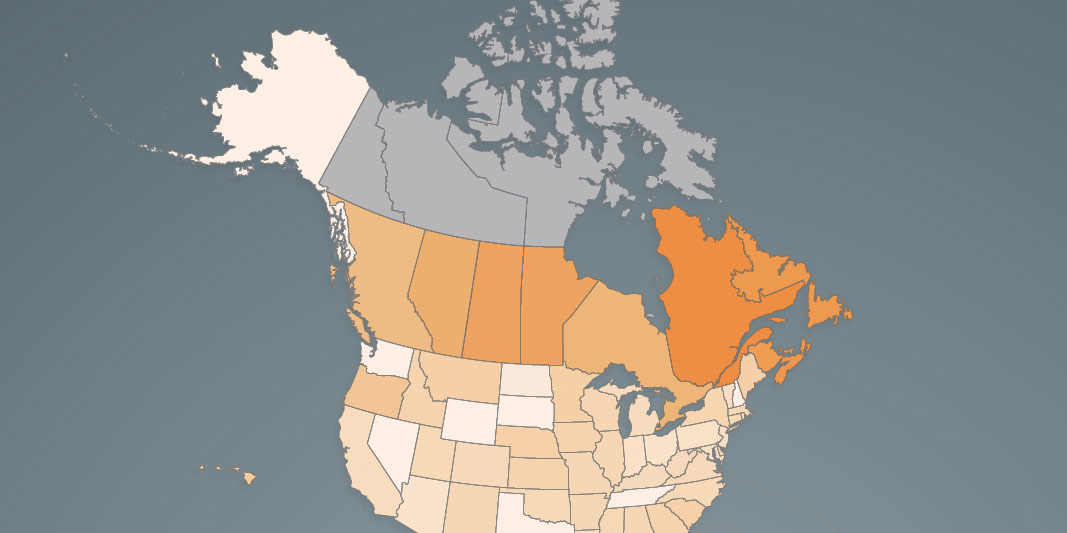
The study offers an empirical analysis weighing the economic
growth rates of resource-dependent states against the Economic
Freedom of North America index to determine the level of
economic freedom required for states to benefit from natural
resource development. Developed by the Fraser Institute, the
Economic Freedom of North America index measures the impact of
economic freedom on the level of economic activity and the
growth of economic activity utilizing 10 components based on
size of government, taxation, and labor market freedom.
Research suggests that in regions lacking policies consistent
with free markets, private-property rights, and a stable and
fair legal system, natural resource dependence can weaken
economic growth-a phenomenon known as the "resource curse."
The study points out that resource-rich states with low
levels of economic freedom may suffer from the "resource
curse." Of the eight most resource-dependent states, Alaska,
Montana, and West Virginia have an economic freedom rating
below 6.22, the critical level necessary to benefit from
natural resource development. Conversely, Louisiana, New
Mexico, North Dakota, South Dakota, and Wyoming all have an
economic freedom rating above the 6.22 threshold, and each
state averages a growth rate 0.84 percentage points higher than
Alaska, Montana, and West Virginia for the period
1986-2005.
"Compounded annually over many years, this gap in growth
rates will create a significant difference between living
standards in the states with a higher level of economic freedom
and those with a lower level," said Fred McMahon, director of
the Fraser Institute's Center for Global Mining Studies.
A comparison of Wyoming and West Virginia, the nation's top
producers of coal, best illustrates this dichotomy. While both
states are among the nation's most resource dependent, Wyoming
is much more so, with coal accounting for nearly 34 percent of
gross state product (GSP) compared to West Virginia's 14
percent. However, Wyoming boasts an economic freedom rating of
6.5, which puts it above the critical threshold to overcome the
"resource curse." As a result of its higher level of economic
freedom, Wyoming enjoys a per-capita gross state product (GSP)
more than $24,000 higher than that of West Virginia, where the
economic freedom score is only 5.3.
"Sound economic institutions are indispensable to economic
growth, and this rings especially true in resource-rich
states," Corey said.
"These states need less government involvement in the
economy, lower taxes, and freer labor markets to truly benefit
from natural resource development."