TORONTO, ON-Government-run auto insurance monopolies in
British Columbia, Saskatchewan and Manitoba are charging some
of the highest average premiums in Canada, concludes a new
report released today by the independent research organization
the Fraser Institute.
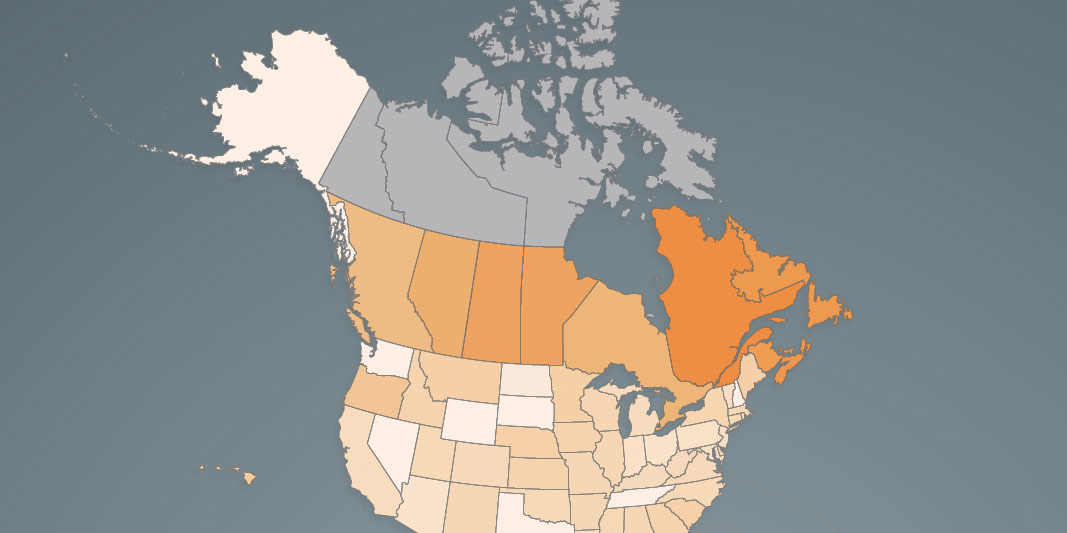
The peer-reviewed report found that drivers in BC pay the
highest average premium at $1,304 annually. At $1,229, Ontario
has the second highest average premium and is the only province
with private, competitive auto insurance that has an average
insurance premium exceeding $1,000. Saskatchewan has the third
highest average premium at $1,063 followed by Manitoba at
$1,029.
"The results suggest that government-run auto insurance is
less efficient than auto insurance provided by a regulated,
competitive market," said Brett Skinner, Fraser Institute
director of health, pharmaceutical and insurance policy
research and author of
Personal Cost and Affordability of Automobile Insurance in
Canada (2008 edition).
"Independent study after independent study come to the same
conclusion: public auto insurance is more expensive on average
than competitive, private models, despite contrary claims by
government auto insurers."
Prince Edward Island has the lowest average auto insurance
premium, at $701, followed by Newfoundland & Labrador
($703), Quebec ($719), Nova Scotia ($749), New Brunswick
($768), and Alberta ($959).
"Quebec is also among the least expensive provinces in
nominal comparisons of average auto insurance premiums, but the
provincial government insurer is restricted to selling basic
coverage only, while the private sector delivers 100 per cent
of the optional auto insurance market," Skinner said.
The study estimates the average cost of personal passenger
auto insurance premiums in all 10 provinces for 2007 using
publicly available data. Varying inter-provincial definitions
for reported data make calculating comparable average premiums
difficult. Government auto insurers do not publish audited data
in a format that permits a simple calculation of average
premiums in their provinces that can be directly compared to
other provinces. In order to estimate and fairly compare the
average cost of auto insurance in every province, the study
applies (by estimation) the same data definitions that
government regulators require from private sector insurers in
six provinces to the published data of the government auto
insurance monopolies in four provinces.
The study found that in British Columbia, Saskatchewan, and
Manitoba, the government auto insurance monopolies occupied 95
to 98 per cent of the market. Additionally, these jurisdictions
tend to require excessive benefits coverage and therefore,
require expensive premiums.
"When consumers are given a choice, they will often prefer a
lower level of benefit coverage in exchange for lower
premiums," Skinner said.
"In jurisdictions where government provides auto insurance,
regulations tend to require drivers to over-insure themselves.
Over-supply or under-supply of goods and services is a typical
result of central planning interference in a market."
The report concludes that the profit motive does not lead to
higher auto insurance costs for consumers. When the private
sector insurance industry is open to competition and consumer
choice is protected, the portion of auto insurance premiums
earned as profits will not result from excessive prices, but
instead come from cost efficiencies achieved by successful
claims management, pricing strategies, customer service, and
good business management. Private sector insurers are also able
to use the returns on invested surpluses that accrue during
profitable years to subsidize premium rates in years where
losses exceed the premiums paid by drivers. Such efficiencies
are lost in government auto insurance monopolies where there
tends to be a higher frequency of claims and suppression of
rates for high-risk drivers below the actuarial cost of
insuring them.
"When auto insurance is provided by government, coverage and
pricing decisions become politicized and are usually not based
on sound economics," Skinner said.
The report recommends that drivers in BC, Saskatchewan, and
Manitoba would be better served by an appropriately regulated
market where auto insurance is obtained from private sector
insurers operating in competition with each other. It also
recommends that Quebec's government auto insurer be made
accountable for its finances, which are in serious long-term
deficit.
"As long as markets are open to competition, minimally
regulated, and consumers have freedom of choice, on average, we
should expect to observe the lowest possible premiums for any
given level of insurance benefit," Skinner said.