

TORONTO, ON-Mining industry executives rate Quebec as the
world's most attractive jurisdiction for mineral exploration
and development for the third straight year, according to the
annual
Survey of Mining Companies 2009/2010
, released today by the Fraser Institute, one of Canada's
leading public policy think-tanks.
"Mining executives say Quebec remains an international
standout for investment because its stable government policies
offer them the certainty that reduces risk for long-term
projects," said Fred McMahon, coordinator of the survey and the
Institute's vice-president of international policy
research.
But while mining executives put Quebec at the head of the
class in Canada, they have a much less optimistic view of
Ontario and British Columbia, citing multiple layers of
regulation, little coordination between various government
agencies, and uncertainty around aboriginal land claims.
Both Ontario and British Columbia, two provinces with a
lengthy history of mining, fell significantly in this year's
survey. Ontario is ranked 22nd overall, down from its 10th
place finish last year, while British Columbia is even further
back at 38th, dropping 14 places from the 24th spot in
2009.
"Ontario's recent throne speech indicated Dalton McGuinty's
government is open to the idea of increased mining in Northern
Ontario, but based on responses from the mining industry in
this survey, the government has substantial work to do at
fixing policies that the industry perceives as discouraging
mining," McMahon said.
The Fraser Institute's
Survey of Mining Companies: 2009/2010
represents the opinions of 670 mining executives and managers
worldwide on the policy and mineral endowment of 72
jurisdictions on all continents except Antarctica. Companies
participating in the survey reported exploration spending of
US$2.9 billion in 2009 and of US$3.6 billion in 2008.
Last year's survey showed significant pessimism towards new
mining investment, but this year's survey reveals a strong
rebound in optimism. Almost twice as many miners plan to
increase investment as hold it steady or decrease it, with 83
per cent of miners saying mining prices will rise and 20 per
cent expecting substantial increases.
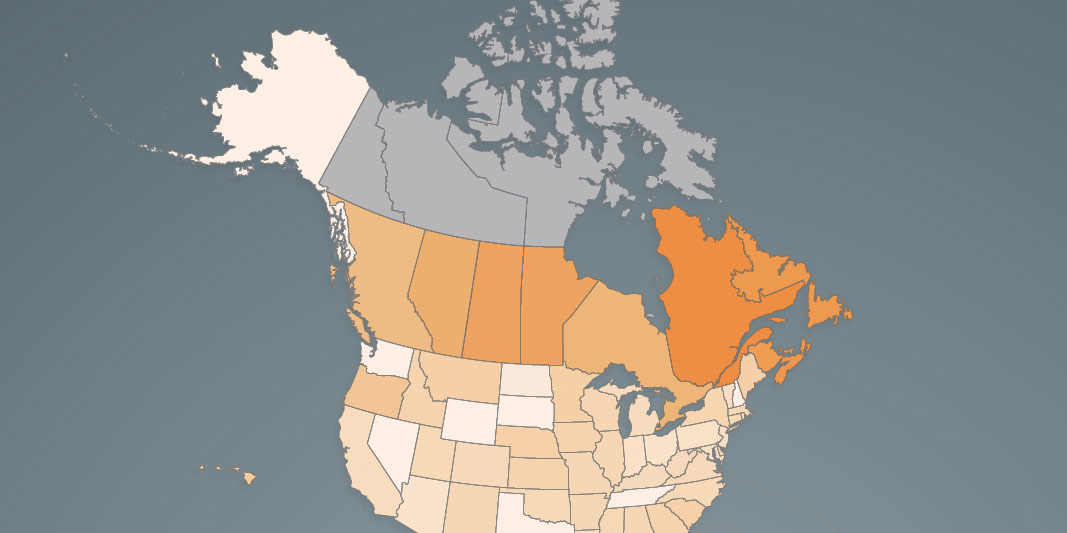
The Canadian picture
Aside from Ontario and British Columbia, Canadian
jurisdictions fared well in this year's survey with Canadian
provinces taking up six of the top 10 spots. New Brunswick is
ranked second overall, an increase of four places since 2009.
Alberta remained in fourth place while Saskatchewan rose three
spots to sixth. Newfoundland & Labrador is ranked eighth, a
decrease from fifth last year, while Manitoba is ranked ninth
overall. In 2007, Manitoba was ranked first overall.
Rankings for other provinces and territories are: the Yukon
in 11th, Nova Scotia in 16th, Nunavut in 43rd, and the
Northwest Territories in 50th.
Significant international developments
Finland is the top international jurisdiction, ranked third
overall. Other jurisdictions in the top 10 include perennial
favourite Nevada at number five; Chile, the only Latin American
country ranked among the top 10, at number seven; and South
Australia, the highest-ranked Australian jurisdiction, at
number 10.
Other highly ranked non-Canadian jurisdictions include
Sweden (12th overall), Wyoming (13th), Utah (15th), and Alaska
(18th).
Among Australian states, South Australia is followed by the
Northern Territory in 14th, West Australia in 19th, and New
South Wales in 20th.
Chile is the top-ranked Latin American nation in seventh
spot overall. It's followed by Mexico (28th), Peru (39th), and
Brazil (40th ).
Botswana is the highest-ranked African nation (21st),
followed by Mali and Ghana in the 27th and 34th spots,
respectively.
The bottom 10 scores belong to Venezuela, Ecuador, the
Philippines, Zimbabwe, Democratic Republic of Congo, Mongolia,
Bolivia, Honduras, Guatemala, and California.
"Respondents say California's staunchly environmentalist
policies create a strong deterrent to investment by interfering
with mining practices that are proven to be clean and
responsible. Unfortunately, the rest of the worst-ranked
jurisdictions are developing nations that urgently need the new
jobs and economic prosperity mining can create," McMahon
said.
"In order to attract mining investment, jurisdictions must
uphold the rule of law and respect negotiated contracts and
property rights. Jurisdictions that fail to do so can not
compete successfully on a global scale."
Optimism on the rebound
Last year's survey presented a gloomy outlook for the mining
industry. This year the outlook is much more optimistic, with
almost twice as many mining companies saying they will increase
exploration budgets as those who said their budgets will remain
the same or decrease. The majority of respondents also expect
mineral prices to increase over the next two years, with 64 per
cent forecasting a moderate rise and 20 per cent predicting
substantial increases.
"As economic recovery takes hold, we're seeing greater
optimism from the mining industry in terms of new explorations
and long-term projects," McMahon said.