Study
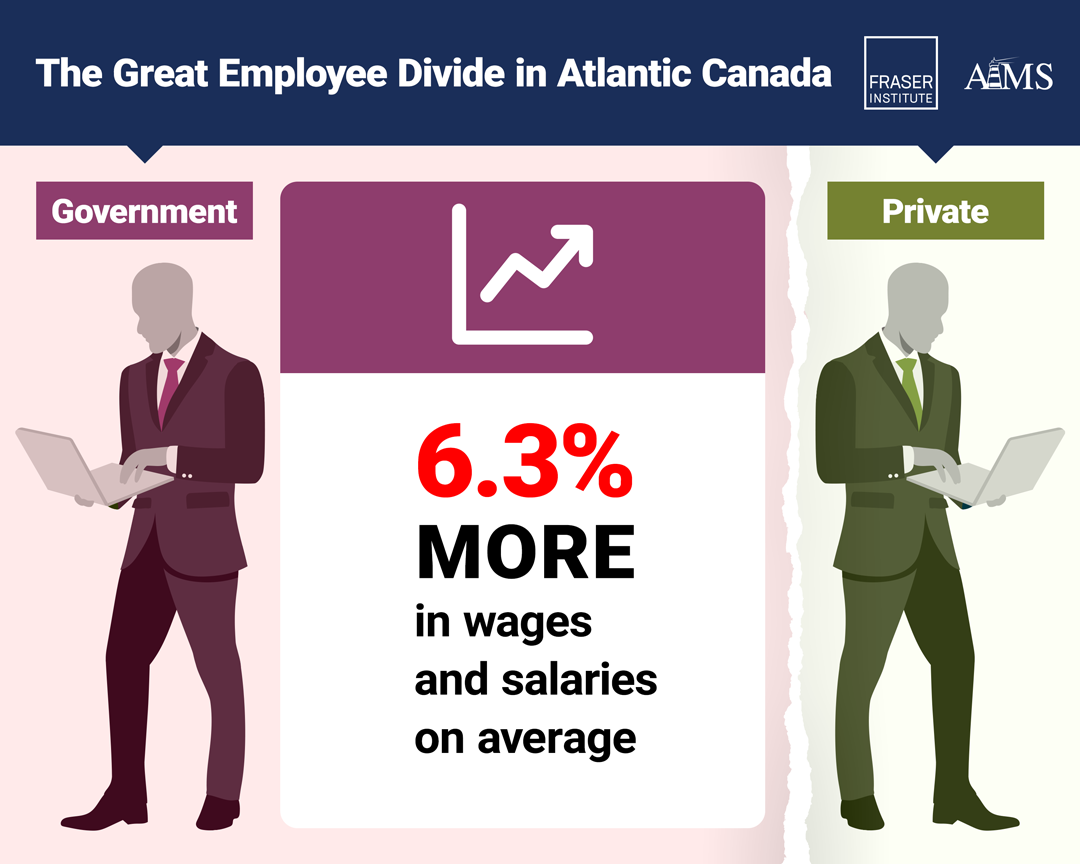
| Temps de lecture estimé 2 MIN.Government workers in Atlantic Canada receive 6.3% higher wages on average than private-sector workers
Comparing Government and Private Sector Compensation in Atlantic Canada, 2026 Edition
- Using data on individual workers from January to December 2024, this report estimates the wage differential between the government and private sectors in the four Atlantic provinces. It also evaluates four non-wage benefits for which data are available to quantify differences in the compensation offered by the two sectors in these provinces.
- After controlling for factors like gender, age, marital status, education, tenure, size of firm, job permanence, immigrant status, province, industry, occupation, and full- or part-time status, the authors found government-sector workers (federal, provincial, and local) in Atlantic Canada enjoyed a 6.3% wage premium, on average, over their private-sector counterparts in 2024. When unionization status is accounted for, the wage premium for the government sector declines to 3.9%.
- Available data on non-wage benefits suggest the government sector enjoys an advantage over the private sector. For example, in all Atlantic provinces, more than 60% of government workers are covered by a registered pension plan compared to less than 25% of private-sector workers. Of those covered by a registered pension plan, government workers are more likely than private-sector workers to enjoy a defined benefit pension.
- Government workers also retire earlier than those in the private-sector—between 2.5 years (Nova Scotia) and 4.2 years (Prince Edward Island) earlier on average—and are much less likely to lose their jobs.
- Full-time workers in the government sector lost more work time in 2024 for personal reasons (from 14.8 days to 19.7 days on average) than their private-sector counterparts (from 8.0 to 11.0 days).
Partager
-
Milagros Palacios
Director, Addington Centre for Measurement, Fraser Institute
Milagros Palacios is the Director for the Addington Centre for Measurement at the Fraser Institute. She holds a B.S. inIndustrial Engineering from the Pontifical Catholic University of Peru and a M.Sc. in Economics from the University of Concepción, Chile. Ms. Palacios has studied public policy involving taxation, government finances, investment, productivity, labour markets, and charitable giving, for nearly 20 years. Since joining the Institute, Ms. Palacios has authored or coauthored over 200 comprehensive research studies, 300 commentaries and four books. Her recent commentaries have appeared in major Canadian newspapers such as the National Post, Toronto Sun, Windsor Star, and Vancouver Sun.… Read more Read Less… -
Nathaniel Li
Senior Economist, Fraser Institute -
Grady Munro
Grady Munro is a former Senior Policy Analyst at the Fraser Institute. He holds a Bachelor of Arts in Economicsfrom Macalester College in Minnesota, and a Master’s Degree in Public Policy at the University of Calgary. Mr. Munro’s commentaries have appeared in major Canadian newspapers including the Globe and Mail, Financial Post, and Toronto Sun. His research focuses on government spending, debt, and taxation.… Read more Read Less… -
Jake Fuss
Director, Fiscal Studies, Fraser Institute
Jake Fuss is Director of Fiscal Studies for the Fraser Institute. He holds a Bachelor of Commerce and a Master’s Degree inPublic Policy from the University of Calgary. Mr. Fuss has written commentaries appearing in major Canadian newspapers including the Globe and Mail, Toronto Sun, and National Post. His research covers a wide range of policy issues including government spending, debt, taxation, labour policy, and charitable giving.… Read more Read Less…
Sujets Connexes
Articles Connexes
Alberta government should save more and spend less
Par: Tegan Hill and Taylor Oliver
Nova Scotia government’s debt accumulation costs Nova Scotians potential tax relief
Par: Alex Whalen
Rising government debt interest—a major risk in Atlantic Canada
Par: Alex Whalen